FSE 150 — Perspectives on Grand Challenges for Engineering
Securing the IoT: AI & Quantum Computing
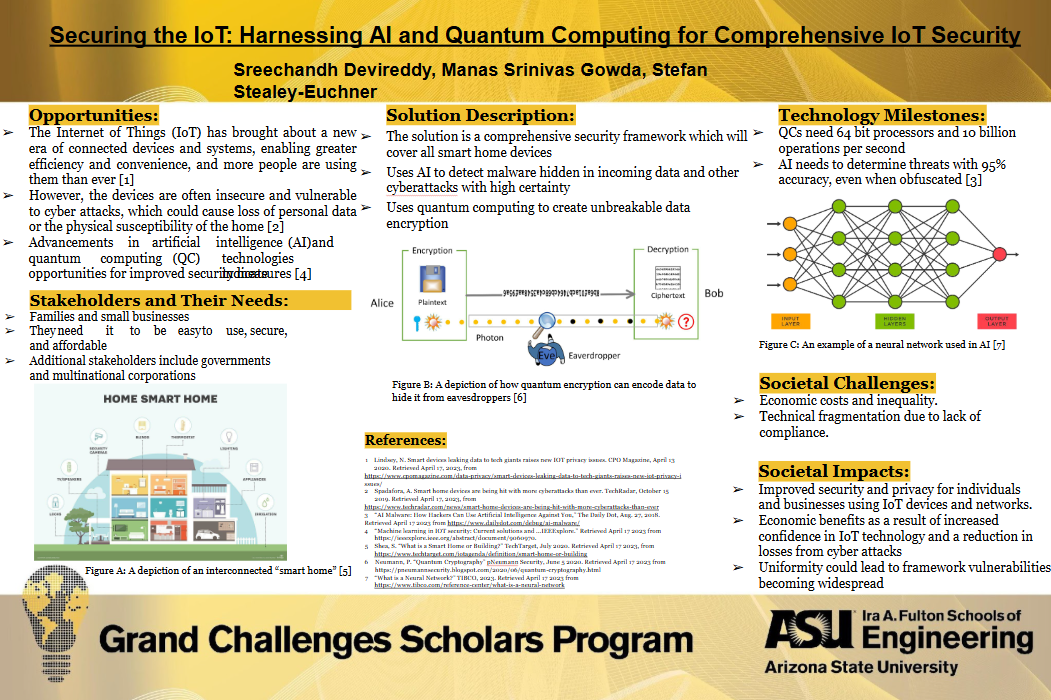
I had a wonderful time till now in the Grand Challenges Scholars Program. My GCSP experience started when I enrolled in FSE 150: Grand Challenges for Engineering. The class had provided me with a lot of opportunities compared to my other classes. This was the only class where I got the opportunity to meet different ASU faculty members, guest speakers, and other ASU professors who are involved in research. Moreover, this class wasn't like my regular engineering classes where we had assignments related to calculus, programming and other related things. The class had fun and interactive assignments which included having a one-on-one conversation with a research professor at ASU, security roleplay, and a debate related to Artificial Intelligence and Bionics. All these different experiences provided me with an interdisciplinary perspective about something outside of my major. One of the most significant assignments in FSE 150 was the Future Solutions project where my team and I worked on a comprehensive security framework to protect IoT smart home devices. Our solution used Artificial Intelligence to detect malware hidden in incoming data and Quantum Computing to create unbreakable data encryption. The project pushed us to think like engineers solving a challenge and gave me my first experience proposing a technological solution to a problem that directly affects people's everyday lives. The poster below is a representation of the work my team and I completed for this project.
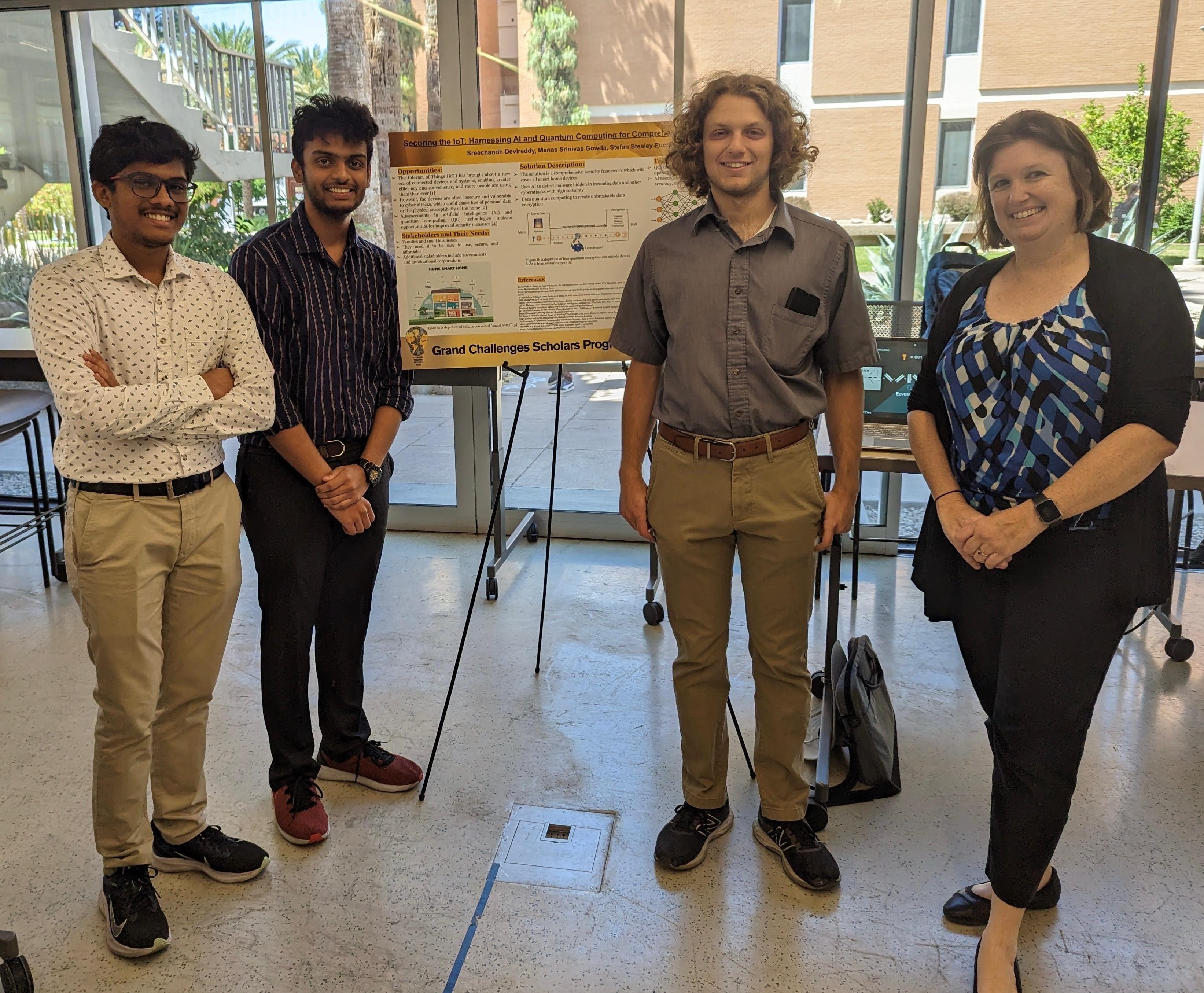
Throughout the class, I met three completely different individuals who had come to the class for giving a Guest Lecture on a particular Grand Challenges theme. At the beginning of the semester, I got the opportunity to meet Dr. Martin Pasqualetti, professor at School for the Future of Innovation in Society and Senior Global Futures Scientist, who had come to the class to talk about Sustainability. The most surprising thing which he mentioned was that even if a particular renewable energy source is cheap, it takes a lot of time for the entire world to shift from the traditional energy source to the new energy source. I was always supporting the world to use renewable energy sources and completely stop the use of traditional ones. After Dr. Martin's guest lecture, I realized that the world needs time to make the shift and cannot happen overnight. The most important thing which I follow and respect from his lecture is that we as individuals need to implement the use of renewable energy as much as possible in our lives because these small implementations tend to make a huge difference in the world.
Secondly, I got the opportunity to meet Dr. Craig Hardgrove, an assistant professor at School Of Earth and Space Exploration and principal investigator of the LunaH-Map mission, during his visit to our class as a guest speaker for Joy of Living Theme. The guest lecture by Dr Craig was by far the most interesting lecture throughout the course. The insights, knowledge and experiences which I have learned from his lecture are applicable in everyone's life. He talked about how his team used CubeSat to collect data from the south pole of the moon using a neutron detector instead of sending in a $1 Billion dollar rocket to the moon. The most important and critical thing which I learned from his professional experience is that every problem can be broken down into smaller pieces and solved individually to solve the bigger problem. This ideology has completely changed the way I look at problems in my engineering courses and my personal life. I have started to break down the problem into smaller pieces and ask myself “How to solve this small issue?” instead of asking “How can I solve this big problem?”. In conclusion, his lecture has completely changed the way I operate.
Moreover, the GCSP experience included lots of interesting activities other than the guest lecture. The most interesting and interactive activity we had in the class was the Security RolePlay during the Security Theme. The roleplay involved many roles such as the President of the United States, National Guard, Governor of Arizona, FEMA representative, Department of Defense, media representatives and citizens. The roleplay was based during a crisis situation where the automated vehicles were completely hacked and there was chaos all across the US highways and roadways. This roleplay got more interesting because of the press conferences given by the Governor of Arizona and the President of the United States while addressing the nation. This activity helped me understand a lot of things. It helped me understand the chain of command, responsibilities of different departments and many other things. However, the most painful thing which I learned was that the media tends to exaggerate things and information causing more chaos in the country. I could resonate how the media, in real life, adds fuel to the burning flame since I was the Governor of Arizona.
All-in-all, this class provided me with the interdisciplinary experience and pushed me out of my comfort zone. The class made me learn 3 research papers for an assignment, which I believe I would never do if I weren't in this class. I got the experience of reading research papers which I believe is crucial for an undergraduate student because we don't get the opportunity to read them in regular classes. Secondly, the class persuaded me to meet a professor involved in research in an one-on-one zoom meeting. Thus, I got the opportunity to meet Dr. Konrad Rykaczewski and discussed his research about the “Mechanism of Sweating at the Microscopic level”. I learnt a lot of things from this discussion that there are professors who are willing to talk to students about their research and also work with them by including them under their team. Secondly, the most important thing I learned is that opportunities are provided to those set of competitive students who are actively looking for one. After the discussion with Dr. Konrad, I realized that everything starts with an email to the professor expressing your interests in their research. I was offered a position in Dr. Konrad's team after the meeting. He provided me with two research papers to study over the summer and start with him in the Fall. I believe that since I already have the experience reading research papers, his assignment won't be hard. Lastly, these are some of the magnificent opportunities offered by this FSE 150 class. The program itself is unique and requires you to push yourself and exceed the limits. This is an interdisciplinary class with lots of opportunities to learn new skills.
SOC 334: Technology and Society
Technology, Society, and the PSA on Generative AI
In the SOC 334 course, I got an opportunity to engage in interesting non-technical discussions and research topics which greatly complemented my technical computer science knowledge. The course was very interesting because we had a weekly discussion on very interesting and non-technical topics such as “Things which I cannot live without!”, “Similarities in responses generated from ChatGPT, Microsoft Co-Pilot”, “Are you using your computers and phones too much or too little?”, “Livelihood with Gig economy”, and “Laboratory Beef!”. These were some of the discussion topics that I liked the most because each one of the topics helped me explore a certain aspect about myself, my family, modern technology and society.
The discussions such as “Things which I cannot live without!” and “Are you using your computers and phones too much or too little?” helped me analyze and think about the way me and my family interact with each other using technology. Additionally, I also learned that if I were ever trapped in a building on fire, I was more likely to grab my phone and escape, instead of already escaping. These discussions helped me learn a bit more about myself because it asked me questions which were basic and common in a way that I would have never thought about during my everyday life. Moreover, discussions such as “Livelihood with Gig economy”, “Similarities in responses generated from ChatGPT, Microsoft Co-Pilot” and “Laboratory Beef!” provided me with an overview of how different people from society interact with technology. For instance, the Gig economy discussion made me realize a very important aspect of society about future jobs. I was surprised to learn about an economy which is not like a “Full-time 9-5 job” environment, but rather was flexible, stress-free and earned decent money. All of these discussions and experiences made me realize that my knowledge in computer science alone won't be sufficient to interact with people. I realized that you always need to bring out your social and humanities knowledge to interact with and work with different people as an engineer.
I also got a chance to complete a non-technical research project in this course where I designed a Public Service Announcement (PSA) at the end of the course. Before this course, I had never heard about a PSA, however, after completing the course I learned about PSA and its critical role in society which was to raise awareness. I designed a Public Service Announcement which was focused on raising awareness about the impacts of Generative Artificial Intelligence (Gen AI) on the “Arts and Media” community. Throughout the research project, I learned some shocking facts about how generative AI copied the original artwork and generated a painting which was sold for $400 million dollars. This made me question the legality and ethical consequences because the datasets for this model were actually paintings from artists. I realized that there was a lot of gray area in the legal and ethical frameworks around the use of generative AI in the Art space. This research experience made me think about the ethical considerations of using AI and how the lack of proper legal framework impacts the arts and media community. What's worse is that we computer scientists are the ones who develop these complex algorithms and machine learning models.
The lessons I learned in SOC 334 were also present in my ENT 360 experience since pitching PeerRent to investors required me to understand not just the product but the society and community I was building it for. The course also made my EPICS project meaningful since it trained me to think beyond the code and consider the people my solution was serving.
Lastly, this course directly relates to my GCSP theme of “Joy of Living” because it complements my technical engineering education with humanities, social sciences, and social interactions. Being an engineer means that you not only have to solve problems, but also have to explain your solutions to society and the world. This is exactly where the humanities and social sciences knowledge will help you connect and interact with society. Since this knowledge of humanities and social sciences is extremely important, I cannot imagine myself being an engineer without these critical skills thereby preventing me from living my life peacefully. Beyond my personal growth, the broader lesson from SOC 334 is that technology can only truly improve people's lives when it is built with an understanding of the society it serves. The discussions around the Gig economy showed me that flexible work arrangements enabled by technology can reduce financial stress and give people more control over their time, which is a direct contribution to a more joyful life. Similarly, the research on Generative AI taught me that engineers who ignore the societal impact of their work risk creating tools that harm communities rather than uplift them. Understanding these facts helps engineers to build things that genuinely contribute to the Joy of Living for all people.
SOC 334 — Public Service Announcement
Arts and Media: The Implications of Generative AI in Content Creation
View PSA Brief